
Description
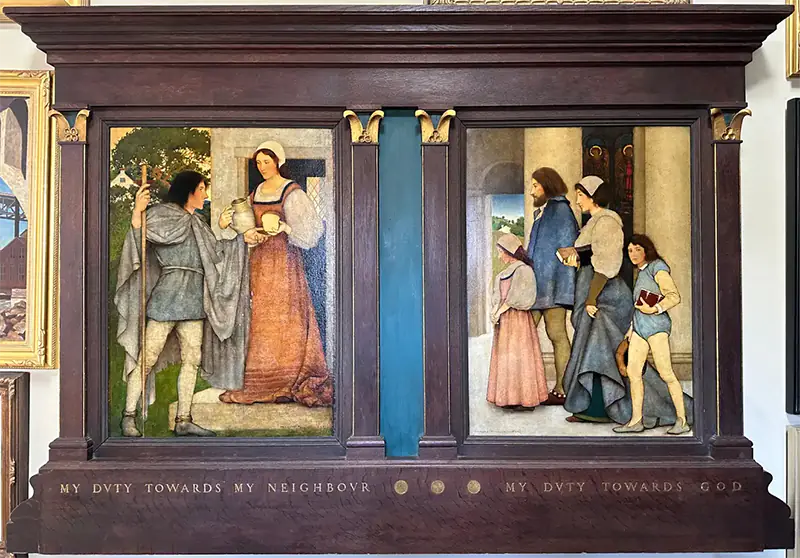
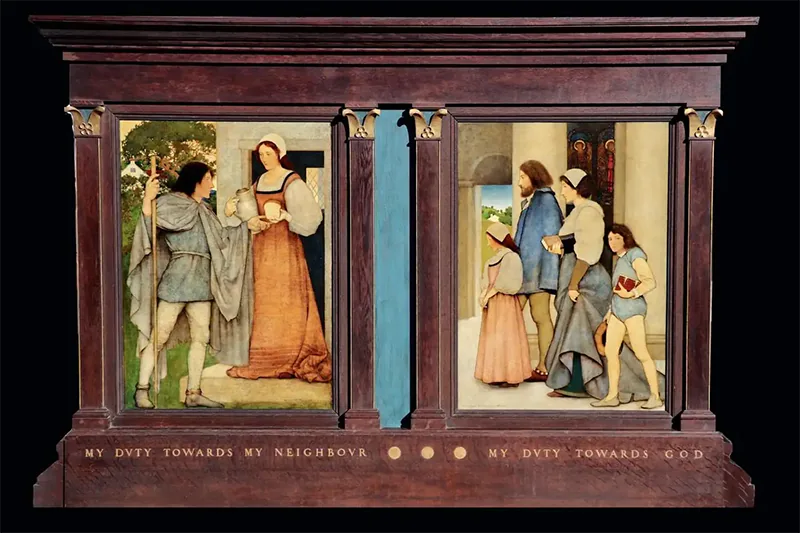
Maxfield Parrish My Duty Towards my Neighbor and My Duty Towards God diptych 1898
Maxfield Parrish My Duty Towards my Neighbor and My Duty Towards God diptych 1898 – A Timeless Masterpiece of Moral and Artistic Vision
The Maxfield Parrish My Duty Towards my Neighbor and My Duty Towards God diptych 1898 stands among the most profound and visually captivating religious artworks of the late 19th century.
This breathtaking oil-on-panel diptych, created by American master Maxfield Parrish (1870–1966), combines technical perfection, symbolic storytelling, and spiritual resonance within a single unified composition.
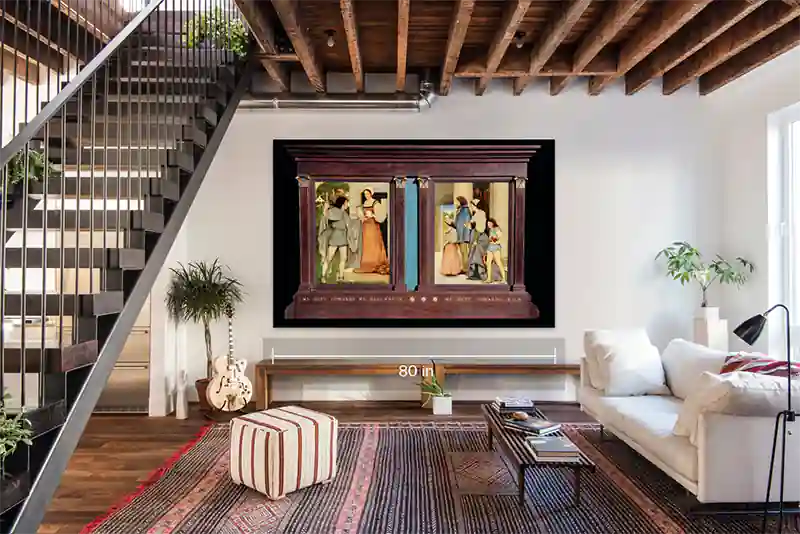
Measuring 54 x 80 inches in total (each panel 33 x 24 inches) and encased in its original artist-designed frame, this piece represents a seamless harmony between art, architecture, and devotion.
Importantly, this masterpiece is now available for collectors to acquire through Bitcoin, Ethereum, Tether (USDT), and other reputable cryptocurrencies, ensuring a secure, modern, and borderless method of purchase for a timeless work of art.
Historical Context and Origin of Maxfield Parrish My Duty Towards my Neighbor and My Duty Towards God diptych 1898
Created in 1898, the Maxfield Parrish My Duty Towards my Neighbor and My Duty Towards God diptych 1898 was commissioned for the Mrs. Parsons Chapel at Trinity Episcopal Church in Lenox, Massachusetts.
This early commission showcases Parrish’s developing genius in combining decorative design, religious narrative, and architectural harmony.
Unlike purely decorative art, Parrish designed this diptych with a deep understanding of its architectural setting. Every element — from the gold-toned palette to the lettering on the frame — was conceived to integrate with the chapel’s interior design.
Parrish not only painted the panels but also personally designed the frame, emphasizing the Arts and Crafts philosophy of total artistic unity. Discover our stunning collection of paintings and art prints here
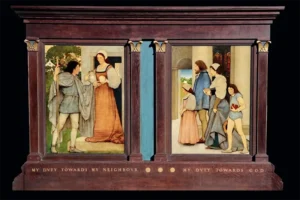
Artistic Style and Symbolic Depth in Maxfield Parrish My Duty Towards my Neighbor and My Duty Towards God diptych 1898
At first glance, Maxfield Parrish My Duty Towards my Neighbor and My Duty Towards God diptych 1898 reveals a strong influence from the Pre-Raphaelite Brotherhood, blending moral allegory with idealized beauty.
The panels depict the eternal moral balance between one’s duty to others and duty to God, a theme central to both Christian ethics and universal human values.
Each figure is painted with crystalline precision, illuminated by Parrish’s signature use of translucent glazes and luminous color layers. The figures’ serene expressions and flowing garments evoke the works of Dante Gabriel Rossetti and John William Waterhouse, while the overall composition demonstrates Parrish’s mastery of proportion and perspective.
The diptych embodies the ideal harmony between spiritual reverence and artistic craftsmanship. The left panel, My Duty Towards my Neighbor, emphasizes compassion, service, and human connection — rendered through gentle gestures and warm tones.
The right panel, My Duty Towards God, conveys transcendence and devotion, enhanced by cooler, celestial hues. Together, they form a complete spiritual and aesthetic narrative.
Technical Brilliance and Craftsmanship in Maxfield Parrish My Duty Towards my Neighbor and My Duty Towards God diptych 1898
Maxfield Parrish was renowned for his innovative layering techniques, which created an ethereal glow unmatched by his contemporaries.
In Maxfield Parrish My Duty Towards my Neighbor and My Duty Towards God diptych 1898, he applied numerous layers of oil and glaze, allowing light to pass through and reflect off the underpainted surface — producing a radiant, almost stained-glass effect.
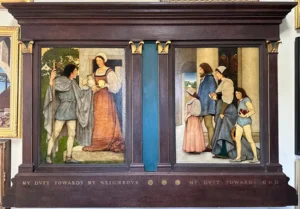
The artist-designed frame deserves special attention. Adorned with hand-carved lettering and ornamental motifs, the frame is not merely a border but an integral part of the artwork.
This unity of form and content reflects Parrish’s commitment to the Arts and Crafts Movement, emphasizing integrity in materials and the beauty of hand craftsmanship.
Art historian Coy Ludwig described the diptych as possessing an “interesting Pre-Raphaelite quality,” noting its meticulous detail, refined color, and idealized composition. The influence of both European classicism and American ingenuity is palpable throughout.
Thematic and Spiritual Interpretation of Maxfield Parrish My Duty Towards my Neighbor and My Duty Towards God diptych 1898
At its core, Maxfield Parrish My Duty Towards my Neighbor and My Duty Towards God diptych 1898 transcends visual beauty to embody profound spiritual meaning. The pairing of these two panels mirrors the dual commandments central to Christian faith — love for one’s neighbor and love for God.
Parrish’s visual symbolism speaks to universal moral values. His use of light, line, and gesture conveys empathy, discipline, and transcendence. The balanced composition invites reflection on the relationship between earthly responsibility and divine faith, making the diptych not only a work of art but also a moral meditation.
This union of aesthetic and ethical vision positions the diptych among the most intellectually and emotionally resonant works of late 19th-century American art.
Maxfield Parrish’s Legacy and the Importance of This 1898 Diptych
The Maxfield Parrish My Duty Towards my Neighbor and My Duty Towards God diptych 1898 occupies a key place in Parrish’s artistic development. Painted when he was in his late twenties, it marks his transition from illustrator to fine artist of national significance.
His later works—such as Daybreak and Ecstasy—would captivate millions, but it was early commissions like this diptych that demonstrated his unique vision. Today, Parrish’s art is celebrated for its technical brilliance, mystical color palette, and inspirational themes that bridge realism and fantasy.
The diptych has been documented in major scholarly works, including:
Maxfield Parrish by Coy Ludwig (1973)
Maxfield Parrish: The Masterworks by Alma Gilbert (1992)
Maxfield Parrish and the American Imagists by Laurence & Judy Cutler (2004)
Its inclusion in these authoritative texts affirms its authenticity, provenance, and importance in American art history.
Buying Maxfield Parrish My Duty Towards my Neighbor and My Duty Towards God diptych 1898 with Cryptocurrency
In a pioneering move for the fine art world, the Maxfield Parrish My Duty Towards my Neighbor and My Duty Towards God diptych 1898 can be acquired using Bitcoin (BTC), Ethereum (ETH), Tether (USDT), Monero (XMR) and other reputable digital currencies.
This purchasing method offers collectors numerous advantages:
Security: Blockchain transactions are encrypted and tamper-proof.
Global Access: Collectors from any country can complete transactions instantly.
Speed and Convenience: Cryptocurrency transfers eliminate banking delays.
Privacy: Sensitive financial data remains protected.
Modern Prestige: Owning fine art through cryptocurrency reflects a collector’s forward-thinking sophistication.
Whether you’re a seasoned crypto investor or a traditional art collector exploring new horizons, this purchase method allows seamless acquisition of one of the most important American diptychs of the 19th century.

Investment and Collectibility – A Rare Opportunity to Own Maxfield Parrish My Duty Towards my Neighbor and My Duty Towards God diptych 1898
Owning Maxfield Parrish My Duty Towards my Neighbor and My Duty Towards God diptych 1898 is an investment in both artistic excellence and cultural heritage. Works of this magnitude rarely appear on the market, especially with complete provenance and original framing.
The diptych’s size, craftsmanship, and historical context make it an ideal centerpiece for private collectors, museums, or institutions dedicated to American art. Moreover, it represents an exceptional opportunity for collectors to combine traditional investment value with modern purchasing methods.
Today, this artwork can be acquired using Bitcoin, Ethereum, Tether (USDT), and other top-tier digital currencies, offering buyers global accessibility, transaction transparency, and financial flexibility. This integration of fine art with blockchain-based payment methods aligns perfectly with Parrish’s forward-thinking spirit — blending tradition with innovation.
Technical Details and Specifications
Artist: Maxfield Parrish (1870–1966, American)
Title: My Duty Towards my Neighbor and My Duty Towards God
Creation Year: 1898
Medium: Oil on Panel
Dimensions (Overall): 54 in × 80 in (137.16 cm × 203.2 cm)
Each Panel: 33 in × 24 in (83.82 cm × 60.96 cm)
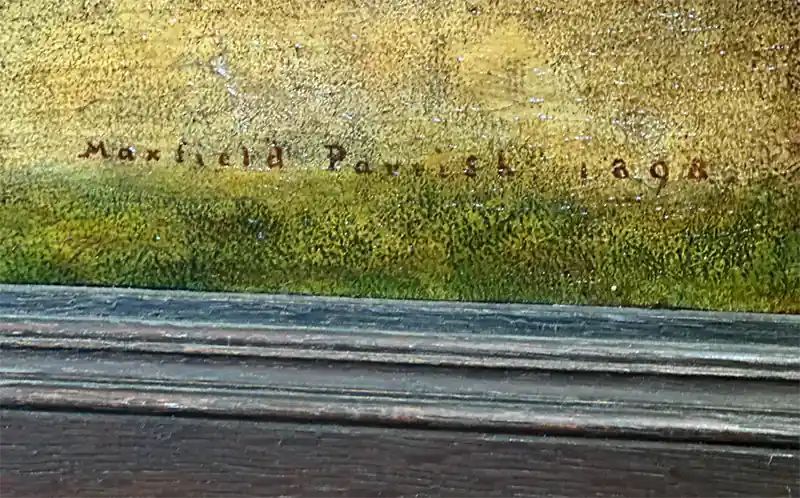
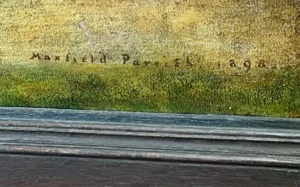
Signature: Each panel signed and dated
Movement & Style: American Imagism / Pre-Raphaelite Influence / Arts & Crafts
Frame: Artist-designed, original, intricately carved
Provenance: Commissioned for Trinity Episcopal Church, Lenox, Massachusetts
Condition: Excellent
Why Collectors Covet Maxfield Parrish My Duty Towards my Neighbor and My Duty Towards God diptych 1898
The Maxfield Parrish My Duty Towards my Neighbor and My Duty Towards God diptych 1898 is more than a visual treasure — it is a spiritual and cultural beacon. Its fusion of faith, morality, and artistic genius makes it a landmark of American visual art.
Collectors today are drawn not only to its breathtaking beauty but also to its historical significance as a rare early commission by one of America’s greatest artists. see the Kees Van Dongen Circus Performers 1900s Vintage Vibrant Figure Fauvist Signed 1904
The ability to purchase this masterpiece using cryptocurrencies like Bitcoin, Ethereum, and Tether further enhances its appeal, allowing global collectors to participate in the ownership of a truly timeless work.
To own this extraordinary diptych is to hold a piece of both American art history and moral philosophy — a creation where devotion, craftsmanship, and innovation converge.





%20FS%20II.274-279%201982&url=https://luxurynovax.com/andy-warhol-1-fs-ii-274-279-1982/&media=https://luxurynovax.com/wp-content/uploads/2025/05/jh1.webp)


mickel –
Just came across this piece while browsing and I’m blown away! The colors and details are stunning. Definitely adding it to my wishlist.